Arriving in Phnom Penh, Cambodia
Cambodia was the only place I'd ever been where the locals told me to watch my back.
We’d only been in Cambodia for about a week, traveling through Siem Reap and the surrounding countryside. The morning we were set to depart for Phnom Penh, our tuk-tuk driver, Nak, warned us to watch ourselves in Cambodia's capital city. Nak had shown us Siem Reap's massive temple complex of Angkor Wat, and had taken us to Tonle Sap lake and the hidden temples pinned to the outskirts of Cambodia's touristy wonderland. He seemed confused as to why we wanted to spend a few days in the capital. Why not stay here a few days longer, or visit the coast, or see other cities like Battambang, he asked? He told us, looking sideways, voice lowered, that there were many “bad people” in Phnom Penh.
I was surprised to hear him talk that way. Countrymen usually speak with nothing but pride about their capital. It's almost always a national bragging point, not a sore spot. But because we had gotten on so well with him, I took what he said seriously.
He was proud of Siem Reap. Like so many young men of his generation, he had left the hard circumstances of the countryside a few years ago to try his luck in Siem Reap, which had recently been pinned to the international tourist map and was booming with tourism. There’s a lot to be proud of there. The image of Angkor Wat is affixed to the national flag, and the city was the seat of the powerful Khmer empire that ruled Southeast Asia for over half a millennium, from 802 to 1431. The temple complex around Angkor Wat comprises the largest religious structure in the world. It’s a place of justified national pride.
Phnom Penh was once called the "Pearl of Asia" for its French-colonial architecture, but it has a decidedly less proud history. In April 1975, Khmer Rouge troops marched into the capital, officially seizing control of the country. In just a few days, the rebel military regime oversaw a breathtaking evacuation of the entire population of Phnom Penh—some 2 million people—to the countryside, where the brutalities of the regime's agrarian revolution awaited.
Nak was born in the 1980s, the first decade of a free Cambodia, the first decade after the Khmer Rouge had (mostly) folded back into the jungle or into the lives they led before the war. Nak and I were born the same year. But in his country, anyone alive in the 1980s was a survivor or a member of the Khmer Rouge, and the former set out to rebuild a country that had been decimated by the latter. ("Decimated," by the way, falls short. The word we use for "utter destruction" refers to the Roman military practice of killing one out of ten soldiers as a disciplinary measure for capital offenses. Cambodia lost at least a quarter of its population. I don't know if there is a word for destruction on that level.)
I figured his suspicion had something to do with this recent historical legacy, and hoped our visit to Phnom Penh would teach us more about what the process of rebuilding this country over the past decades had entailed.
At the airport in Siem Reap, Nak handed me my bags, and reminded me to hang on tight in Phnom Penh. Get in, and get out, he nodded at me. As we hugged him goodbye and walked into the airport, I wasn't nervous, but I was curious to understand where this suspicion was coming from.
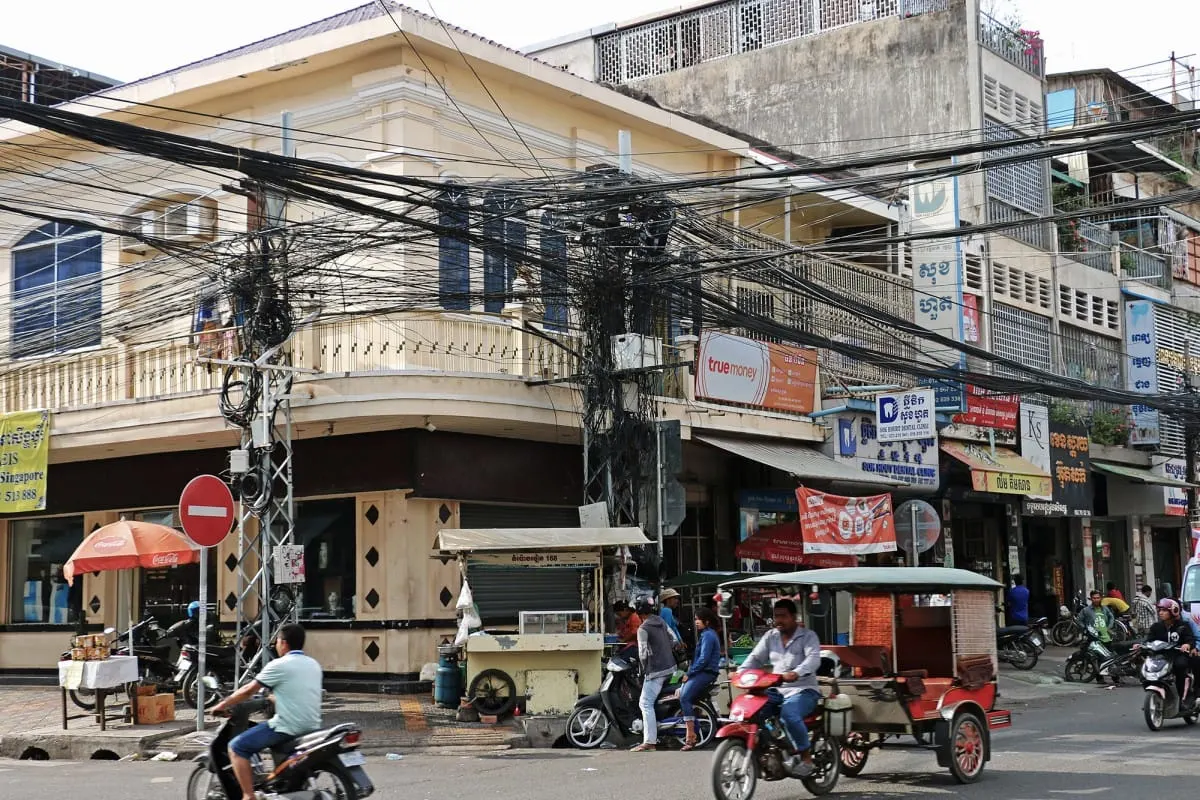
The flight was over in 30 minutes flat, and as soon as we stepped out of the airport and into Phnom Penh, we came onto a highway choked with scooters and trucks and tuk-tuks, horns blaring, smog dispersing the direct sun into a gentler daylight. The main road into and out of the city. The same road where in 1975 the Khmer Rouge had evacuated the city’s 2 million residents.
We hired a tuk-tuk to take us to our downtown guesthouse. Our driver stowed the luggage under our feet, and motioned for us to hold onto it. I figured we were in for a bumpy ride, but as we turned onto the main road, he gestured at us to watch out for scooters. He mimed a scooter driver reaching into the open cab of the tuk-tuk to grab a bag that wasn’t held down. During the drive, he kept glancing back at us, making sure we were holding onto our bags. He grew agitated when I forgot myself and took out my phone to take a picture. More suspicion, a first confirmation of what Nak had been talking about.
It's only about 15 kilometers from the airport to downtown Phnom Penh, but it took over an hour, and according to the driver, the traffic was like this any time day or night. The cars move a tick faster than walking pace, scooters travel both with and against opposing traffic, and stop lights are mostly ignored. Intersections seem to be governed by the principle of whoever gets there goes.
My first impression was that Phnom Penh had the frantic pace and scooter density of Ho Chi Minh City with the sprawl, haphazard urban planning, and grit of Mumbai. Siem Reap, on the other hand, was a place that felt like it had only recently grown out of being a village. Phnom Penh was clearly a different beast, with a big underbelly.
When we got to the guesthouse near the riverfront, just a few streets over from the Royal Palace complex, our host gave us a glimpse of the things on offer in Phnom Penh. In addition to the standard tours, one of the brochures she presented us with was for a shooting range outside of the city, where tourists can throw grenades, shoot military-grade machine guns, and fire rocket launchers. For just $150, the shooting range will even build a small hut to bomb with their rocket launchers (advance notice required).
We passed on the tours, telling her we wanted to wander around to get the lay of the land. She shrugged, and pointed to my bag, gesturing to hold it tight.
Just south of the hotel was the Royal Palace and museum complex area. It's an impressive building, with those flame-like tips curling seductively towards the sky, the king pictured waving benevolently to his people.
In front of the Palace, two teenage girls, one with a baby on her hip, approached us, holding out bags of popcorn. I asked if the popcorn was sweet or salty (I don't like sweet popcorn). They shook their heads. They didn't understand. I pulled out my phone and typed the two words into Google Translate. They shook their heads again, lowered their eyes, and walked away. I had been prepared to buy their wares. Confused by their bashfulness, I stood there wondering what had just happened. Maybe they didn't speak Cambodian. Maybe they were an ethnic minority. Or maybe they couldn't read. I should have just bought it. By the time I realized this, though, they were gone.
As dusk fell on the city, we walked in the opposite direction of the palace towards the commercial center of the downtown area. Many of the restaurants and stores advertised themselves as social businesses, established by NGOs working to provide career training to the country's exploited and underserved—former sex workers, the disabled, landmine survivors, child laborers. The commercial core of this area seemed to be made up largely of businesses like these, along with enterprising tuk-tuk drivers, incessantly whistling, asking if you need a ride.
Within a few blocks, we came upon the Red Light district. The clubs were just gearing up for the night ahead, switching on neon lights and setting up tables and chairs that spilled into the street. Female sex workers, some suspiciously young, scanned the crowds, calling out at men, including my husband, who was walking at my side, to come in and have a good time. Some even gestured for me to come in.
European and American men of all ages, but mostly old, sat drinking beer at the tables set up outside of the clubs, their dates draped over their laps, hands roaming. Crude motions and cruel laughter. I wondered if they saw how the women squirmed under their touch.
Other women were still waiting for the first client of the night. It was still early, and they were adjusting their makeup, using their smartphones as a mirror, clipping their fingernails or combing their hair. Others hanging listlessly off a chair, foot tapping slowly in the air, or nonchalantly leaning against a wall, as if playing hard to get.
Just a few meters away from this area, families and street vendors and beggars and young couples strolled along the wide promenade on the muddy, slow-moving Mekong.
A man missing both his hands and feet scrambled along the street on his calloused stumps, moving improbably fast past palms fluttering in the evening breeze.
Under one of those palm trees, a white man sat down on a bench next to a Cambodian woman and her young girl, no more than eight years old. I gasped when suddenly, he grabbed the girl by the jaw, forcing open her mouth, jerking her left and right. Inspecting her mouth, like one might a horse.
I didn't know what it all meant, but I was beginning to understand where the unease and suspicion came from. Though for me, it was the white male tourists I was most suspicious of.
Early the next day, we went to the Tuol Sleng Genocide Museum. This is probably the biggest tourist "attraction" in Phnom Penh, this museum of murder. The former high school—airy classrooms arranged around a wide courtyard—was enclosed behind unassuming walls in a quiet residential neighborhood just southeast of the downtown. It had been repurposed by the Khmer Rouge as a prison, and has since become a sign of the atrocities of the regime.
We parked our rented scooter just outside of the gate, and as we were putting our helmets away, a group of middle-aged men came up to us, telling us we shouldn't park there. It's not safe. One took the scooter and guided it into the museum, where a guard kept watch. For all the suspicion in the air, the strangers we met all went out of their way to look after us. We were shown nothing but friendliness and consideration by the Cambodians. Who they were protecting us from, I didn't know.
At the museum, we learned that from 1975 to 1979, Cambodia was probably the scariest place in the entire world. The Khmer Rouge wanted a peasant revolution, and anyone who wasn't a peasant was slated to die. Speaking a foreign language or even wearing glasses was enough to make you an enemy of the state. Over 17,000 of these so-called state enemies were processed through this prison, where they were photographed, questioned, and tortured before being dispatched to certain death in the Killing Fields.
We spent hours in the permanent exhibition, completely absorbed, and after, we sat, dazed, on a bench in the courtyard. A sign announced that in just a few minutes, a survivor would be speaking in the lecture room.
We took a seat in the front. These were the only seats left, as if the audience were hanging back, too shy to get closer to the survivor. The audience was all European, and at the front sat a middle-aged Cambodian woman with a young man.
She began to speak, through her translator, telling the story of her survival. She looked so unassuming, sitting up there, just an average woman you would see on the street, at the market, taking her kids to school. She had been just a little girl when the Khmer Rouge came to power, young enough to barely remember life before everything changed. Her father had been shot, and she and her mother were evacuated to the country, where they were forced laborers on a farm. They ate tarantulas to survive.
At the beginning of her story, she looked upwards at the ceiling, and as she continued to talk, her eyes searched out into the room, and then settled, unwaveringly, on my husband. And she then continued.
Out of this room of survivors, she chose him to tell her story to. I wondered what she saw in him, why she had entrusted him with her story. Also, why she had not chosen me. I wanted to know too.
I was only in Cambodia for a few weeks, and I can't presume to know what all of this means. I only know what I observed: it's a country that is still very tough for many of its people, and its history seems to weigh heavily on the present. But there is also a strong sense of forward momentum, of hope and progress, and we were received there with conspicuous kindness and generosity.
Still, Cambodia remains the only country I've been to where I heard locals express so much suspicion about their fellow countrymen, especially in Phnom Penh. This atmosphere of suspicion must have something to do with this history. Watching the survivor speak, I realized that virtually everyone in Cambodia over the age of 45 is a survivor. Or a perpetrator. And in a big place like Phnom Penh, it must not always be clear who’s who.
January 2017.